Content marketing has never been more prolific. Ebooks, guides, reports, and long-form posts are published at a relentless pace across nearly every industry. Yet alongside this growth, a quieter problem has emerged.
Most teams can tell you how many people downloaded an ebook or accessed a guide. Far fewer can tell you how many people actually finished reading or listening to it. Even fewer understand how this difference changes outcomes.
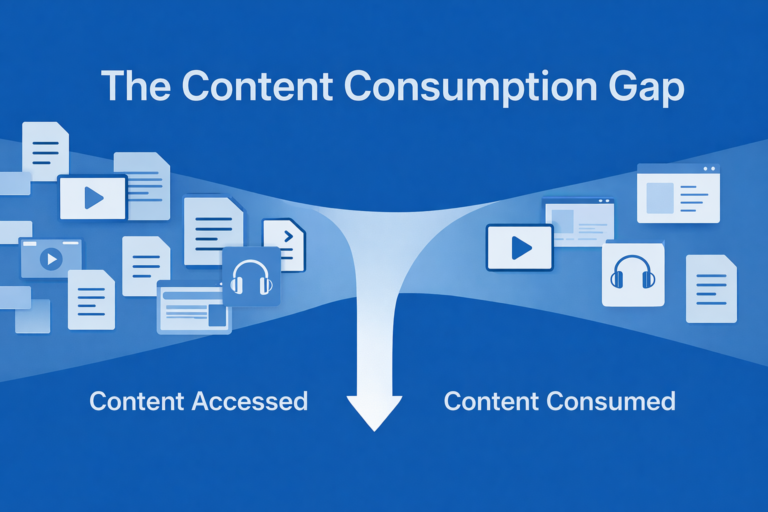
This blind spot creates what can be described as the Content Consumption Gap: the widening gap between content that appears successful based on surface metrics and content that is genuinely absorbed, understood, and acted upon.
This article defines the content consumption gap, explains why it exists, examines how large it can be in real-world scenarios, and explores practical ways teams are beginning to reduce it.
What is the content consumption gap?
The content consumption gap refers to the difference between three distinct stages in the life of a piece of content:
- Content that is created and published
- Content that is accessed, clicked, or downloaded
- Content that is actually consumed end-to-end
In practice, these three numbers are rarely aligned. A piece of content may generate significant interest and visibility while still failing to deliver its core message to most of its audience.
The gap matters because long-form content is usually designed to do its real work near the end. Arguments are developed gradually. Evidence is layered in. Conclusions and implications are often reserved for later sections. When most readers never reach that point, the content’s purpose is undermined.
Description: Funnel-style diagram showing drop-off from ebook download to completion.
Filename: content-consumption-gap-funnel.png
Alt text: Content consumption gap showing how many people download content versus finish it
How we got here
For many years, long-form written content was the default way to explain complex ideas. Reading a whitepaper or guide was a normal part of professional life. The environment supported sustained attention.
That environment has changed. Information is now consumed in shorter bursts, across more devices, and alongside a constant stream of interruptions. The format of content has not always evolved at the same pace as behaviour.
As a result, many modern content assets are structurally sound but contextually misaligned with how people actually engage with information. The content consumption gap is the visible symptom of that mismatch.
Why the gap exists
The content consumption gap is rarely caused by poor quality. It is primarily driven by behavioural and structural factors that shape attention and effort.
Fragmented attention
Sustained reading requires focus. Most people encounter content while multitasking, switching contexts, or operating under time pressure.
Format assumptions
Long PDFs and dense articles assume a quiet reading environment. Interest alone does not create that environment.
Deferred intent
Downloading content is often an act of intention rather than action. Many assets are saved with good intentions and never revisited.
Cognitive load
Complex material requires mental energy. When that energy is depleted, abandonment increases sharply.
Opt-ins versus real consumption
Opt-ins are a measure of willingness to exchange information for access. They are not a reliable measure of comprehension or engagement.
Directional benchmarks suggest opt-in rates are often similar across different formats when the underlying offer is unchanged:
- PDF only: ~10%
- Audio only: ~10%
- PDF + audio: ~12%
The real divergence appears after access is granted, when people decide whether to invest attention.
Description: Bar chart comparing opt-in rates for PDF, audio, and combined formats.
Filename: opt-in-rate-by-format.png
Alt text: Opt-in rate comparison between PDF, audio, and PDF plus audio formats
Who actually finishes long-form content?
Completion rates expose the scale of the content consumption gap. Even highly relevant material experiences steep drop-off.
Typical completion ranges based on reading behaviour, podcast completion, and long-form engagement research are:
- PDF documents: ~10%
- Short-form audio: ~35%
- PDF + audio bundles: ~45%
Audio often performs better because it fits into moments that would otherwise be inaccessible to reading.
Description: Completion rate comparison across content formats.
Filename: content-completion-rate-by-format.png
Alt text: Content completion rates for PDF versus audio versus combined formats
The economics of attention
Attention is a finite resource. Every piece of content competes not only with alternatives, but with everything else demanding mental energy.
When consumption requires high effort, only the most motivated individuals persist. The content consumption gap reflects this natural filtering.
Formats that reduce effort without reducing substance tend to retain more of the audience.
Why completion changes outcomes
Completion signals more than exposure. It indicates that the audience has engaged deeply enough to process and evaluate the information.
Research consistently links deeper engagement with stronger outcomes. Fully-consumed content is often associated with conversion rates 1.5× to 3× higher than skim-level engagement.
Description: Multiplier chart showing higher conversion likelihood for fully-consumed content.
Filename: consumed-vs-skimmed-conversion-uplift.png
Alt text: Conversion uplift when content is fully consumed rather than skimmed
How to measure the content consumption gap
Measuring the gap requires separating access from progression. Downloads and views indicate interest. Consumption indicates engagement.
- Scroll depth on long pages
- Percentage of audio or video completed
- Time spent relative to content length
Identifying the point where core value is delivered reveals how many people actually reach it.
Common misconceptions
“Downloads equal success”
Downloads measure access, not understanding.
“Shorter content always performs better”
Length is less important than alignment with consumption behaviour.
“Publishing more solves the problem”
Volume increases exposure, not comprehension.
Structural ways to reduce the gap
- Surface key insights earlier
- Reduce unnecessary friction
- Offer alternative consumption formats
- Design for interruption
- Measure completion explicitly
An example of closing the gap in practice
One approach involves pairing written content with audio. The same material can then be consumed in different contexts.
Tools such as Auripath convert long-form text into audio ebooks, making it easier to identify which content is actually finished rather than simply accessed.
The underlying shift is from measuring exposure to measuring understanding.
FAQ
Is the content consumption gap real?
Yes. Completion metrics consistently show that most long-form content is only partially consumed.
Are ebooks still worth producing?
Yes, but their effectiveness depends on whether people actually finish them.
Does audio replace written content?
No. Audio complements text by expanding when and how content can be consumed.