
Where Service as Software Can Fail

Service as Software is not magic. It can fail badly if companies treat it like a buzzword rather than a delivery model.
1. The service is not repeatable enough
Some services are messy, bespoke, and dependent on human judgement. If every customer needs a different process, it is hard to turn the work into software.
2. The AI output is not reliable enough
If the workflow needs high accuracy, the product must include QA, review steps, audit trails, and clear accountability. This matters even more in legal, financial, medical, compliance, and regulated industries.
3. The company hides human labour
Some businesses claim to be AI-powered but rely heavily on manual back-office work. That can be fine early on, but it is not truly scalable unless the human work decreases over time.
4. Pricing does not match the outcome
Traditional SaaS often prices by seats, usage, or tiers. Service as Software may need pricing based on completed tasks, delivered outcomes, managed workflows, or value created.
5. Customers do not trust the automation
For many buyers, especially in B2B, trust is a major barrier. They need to know what the AI is doing, where the data goes, and how mistakes are handled.
6. The product is just a thin wrapper
A basic AI wrapper around a single prompt is not enough. A strong SaS product usually needs workflow automation, data handling, integrations, review logic, reporting, and a clear customer outcome.
How to Build a Service as Software Product
If you are a founder, consultant, agency, or SaaS operator, the best starting point is not “add AI.” It is “find a repeatable service outcome.”
Step 1: Pick one outcome people already pay for
Do not start with a vague workflow. Start with a result that buyers already understand.
Examples:
- generate qualified sales leads
- turn a PDF into a content asset
- produce a monthly financial report
- create product research insights
- write and publish SEO content
- monitor compliance issues
Step 2: Map the human workflow
Write down every step a human service provider would normally take.
For example:
- receive the brief
- inspect the source material
- ask follow-up questions
- perform the work
- review quality
- deliver the output
- report results
Step 3: Separate judgement from routine work
Routine work is easier to automate. Judgement-heavy work may need human review, at least at first.
This is where many Service as Software products should start as human-in-the-loop systems.
Step 4: Automate the predictable parts
Use AI automation, APIs, and workflow automation to remove repetitive work.
This might include:
- document analysis
- classification
- content generation
- data extraction
- task routing
- report creation
- notifications
- CRM updates
Step 5: Build quality control into the workflow
Service as Software needs trust. That means the system should not just generate outputs. It should help verify them.
Add checks such as:
- confidence scoring
- review queues
- change logs
- approval steps
- fallback to human review
- clear error handling
Step 6: Price around the outcome
If the product delivers a service, price it like an outcome, not only like software access.
Possible pricing models include:
- per completed workflow
- per asset produced
- per lead generated
- per report delivered
- monthly managed package
- setup fee plus ongoing software plan
Step 7: Expose the workflow over time
Once the workflow is stable, you can make it more AI-first.
That might mean adding:
- public API endpoints
- agent-friendly documentation
- webhooks
- workflow integrations
- MCP support
- CLI access
- LLM-readable docs
But this should usually come after the outcome is proven. Open endpoints are useful when there is already a repeatable process worth exposing.
Is Service as Software a Real Business Opportunity?
Yes, but not every SaaS product should become SaS.
The model is strongest when:
- the customer wants an outcome more than a tool
- the workflow is repeatable
- AI can perform a meaningful part of the work
- there is a clear before-and-after result
- the buyer has budget for the service being replaced
- the company can maintain quality as it scales
It is weaker when the workflow is too bespoke, the data is too poor, the output is too risky, or the buyer does not trust software to perform the job.
For many startups, the practical route may be:
- start with a done-for-you service
- standardise the workflow
- use software internally
- automate the repeatable parts
- sell the outcome
- turn the process into a product over time
That path is not as glamorous as launching a pure self-serve platform on day one. But it may be more realistic, especially when the category is new and buyers need help understanding the value.
Conclusion: Service as Software (SaS) Is About Outcomes, Not Tools
Service as Software (SaS) is not just a new acronym. It reflects a deeper shift in how software, AI services, AI agents, and workflow automation can deliver business value.
SaaS gave companies access to tools. Service as Software pushes toward something more direct: software that performs more of the service and delivers the result.
For founders, agencies, consultants, and B2B operators, the opportunity is to look at the services customers already pay for and ask:
Which parts of this outcome can software now deliver?
The answer will not always be “all of it.” In many cases, the best model will be AI-powered services with human review. But even that can be a powerful step toward more scalable, more repeatable delivery.
Tools like Auripath are building toward this kind of workflow in the B2B content space, where static PDFs can become more useful, measurable, and accessible content assets over time.
The next step: choose one repeatable customer outcome, map the current human workflow, and identify which parts AI and software can reliably deliver today.

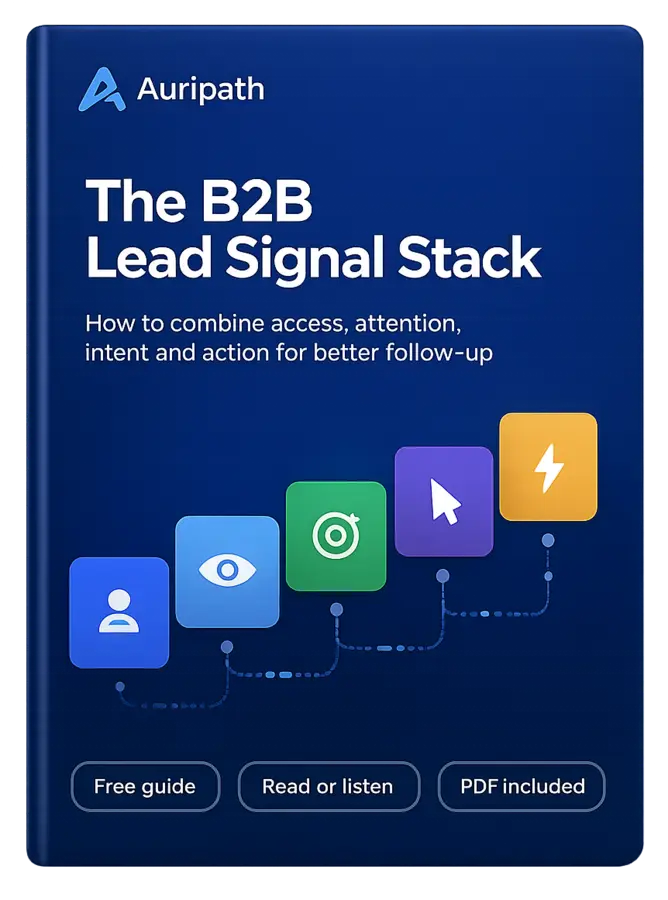
Get the free audio ebook for better B2B follow-up.
Learn how to turn PDF downloads, listening behavior, and CTA clicks into stronger sales conversations.
Frequently asked questions
What does Service as Software (SaS) mean?
Service as Software (SaS) means using software, AI automation, and AI agents to deliver a service outcome, rather than simply selling access to a software tool. The buyer pays for the result, not just the dashboard.
Is Service as Software the same as Software as a Service?
No. Software as a Service (SaaS) gives customers access to cloud software. Service as Software (SaS) uses software to perform more of the service itself. SaaS helps the customer do the work. SaS aims to deliver the work.
What are examples of Service as Software?
Examples include AI-powered marketing execution, AI-moderated user research, automated bookkeeping workflows, AI legal document generation, and B2B content repurposing workflows that produce finished assets instead of just providing tools.
Why is AI making Service as Software more viable?
AI can now handle more language, reasoning, classification, generation, and workflow tasks than older software could. When combined with APIs and workflow automation, AI can perform more of the service process end to end.
What are the risks of Service as Software?
The main risks are poor output quality, lack of trust, weak data, compliance issues, hidden manual labour, unclear accountability, and trying to automate services that are too bespoke or judgement-heavy.
How can a company start building a Service as Software product?
Start by choosing one repeatable service outcome. Map the current human workflow, automate predictable steps, keep human review where needed, add quality control, and price around the result rather than only software access.
Get the free audio ebook for better B2B follow-up.
Learn how to turn PDF downloads, listening behavior, and CTA clicks into stronger sales conversations.