Inheritance tax guide leads can be valuable for wealth managers, financial advisers, estate planners, and advisory firms.
But only if the guide is actually consumed.
Most firms already have useful educational guides. They may cover inheritance tax, estate planning, wealth transfer, legacy planning, or passing assets to the next generation.
The problem is not always the quality of the guide.
The problem is that a PDF download does not prove much.
Someone can download a 22-page guide, leave it in their inbox, forget about it, and never come back. On paper, that person looks like a lead. In reality, they may have consumed nothing.
That is a problem if your firm is relying on long educational PDFs to generate high-value conversations.
Inheritance tax content is not casual content. It touches family, legacy, privacy, wealth transfer, and long-term decision-making. That means the way people engage with it matters.
A good inheritance tax guide can still be one of the most valuable resources on a wealth manager’s website. But if it only exists as a static PDF, you may be missing a lot of the intent signals that happen after the download.
That is where audio can help.
Not as a gimmick. Not as a replacement for the approved guide. And not as a way to add extra advice.
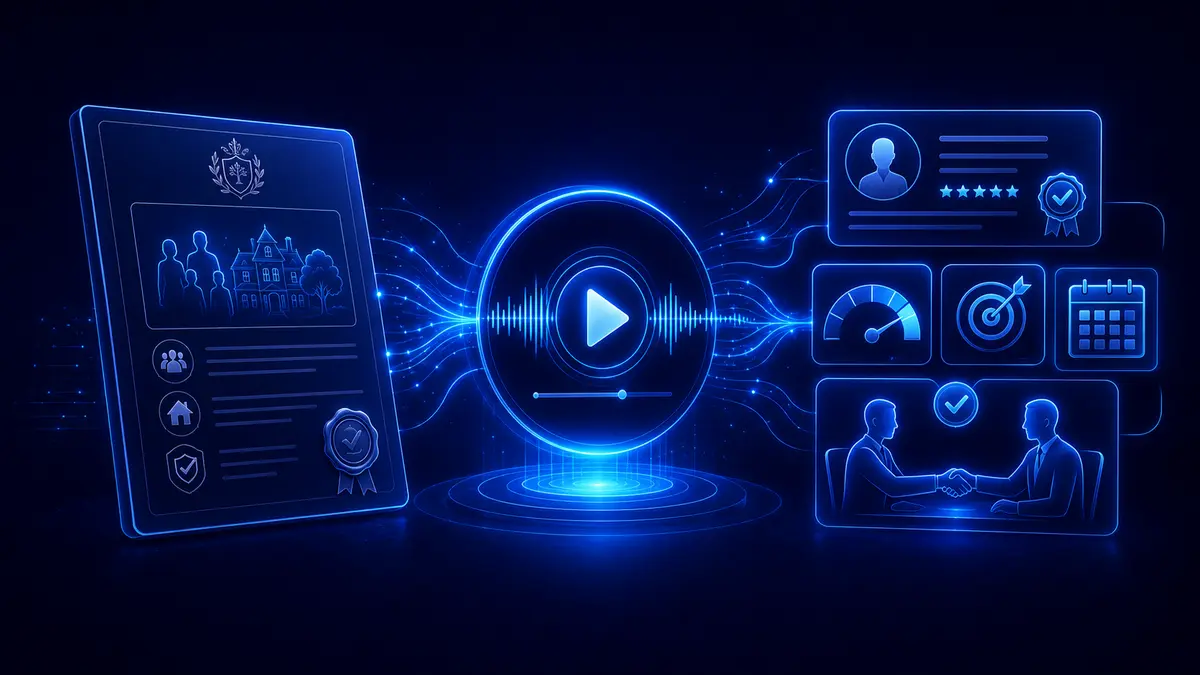
Audio can turn an existing adviser-approved guide into a more accessible, more measurable, and more useful lead-generation asset.
In this article, we will look at how wealth managers can turn inheritance tax guides into higher-value leads using audio, landing pages, paid promotion, referral partner distribution, and engagement tracking.
Important: This article is for general marketing and content strategy information only. It is not financial, tax, legal, investment, or estate planning advice. Rules and requirements vary by jurisdiction. Firms and readers should seek guidance from appropriately qualified and regulated professionals in their own jurisdiction before acting.
Why inheritance tax guides are valuable for wealth managers
Inheritance tax guides work well because they sit at the intersection of education, trust, and timing.
Many prospects are not ready to speak to an adviser immediately. They may be researching quietly. They may be discussing the topic with a spouse, adult children, parents, or other family members. They may simply be trying to understand whether the subject is relevant to them before they make contact.
That makes an inheritance tax guide a strong first step.
It gives the prospect a low-pressure way to engage with your firm before they request a conversation.
Research from Capgemini shows that many high-net-worth individuals want firms to provide value-added services around areas such as family wealth, inheritance, estate management, and related professional services.
That does not mean your marketing page should teach technical tax rules. It means there is a clear appetite for trusted educational content around these subjects.
And that is the opportunity.
If your firm already has an approved inheritance tax guide, the next question is not “should we create more content?”
The better question is:
“How do we get more of the right people to actually consume this guide, trust it, and take the next step?”
The problem with PDF downloads
PDFs are useful. They are familiar. They are easy to send. They are easy for internal teams, advisers, and compliance reviewers to check. They are easy for referral partners to share.
But PDFs have one big weakness.
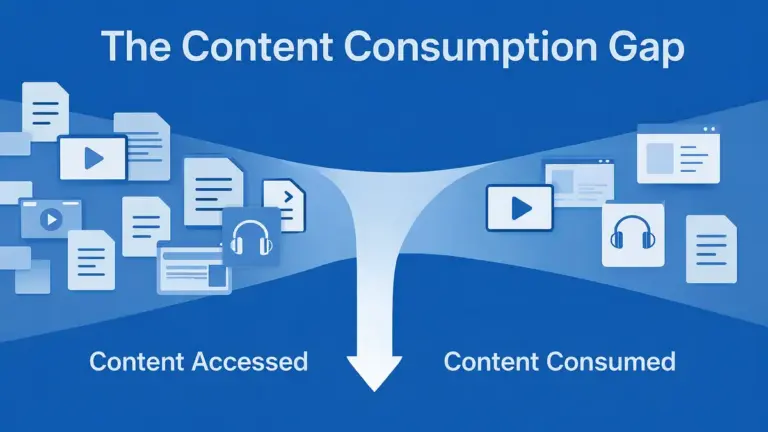
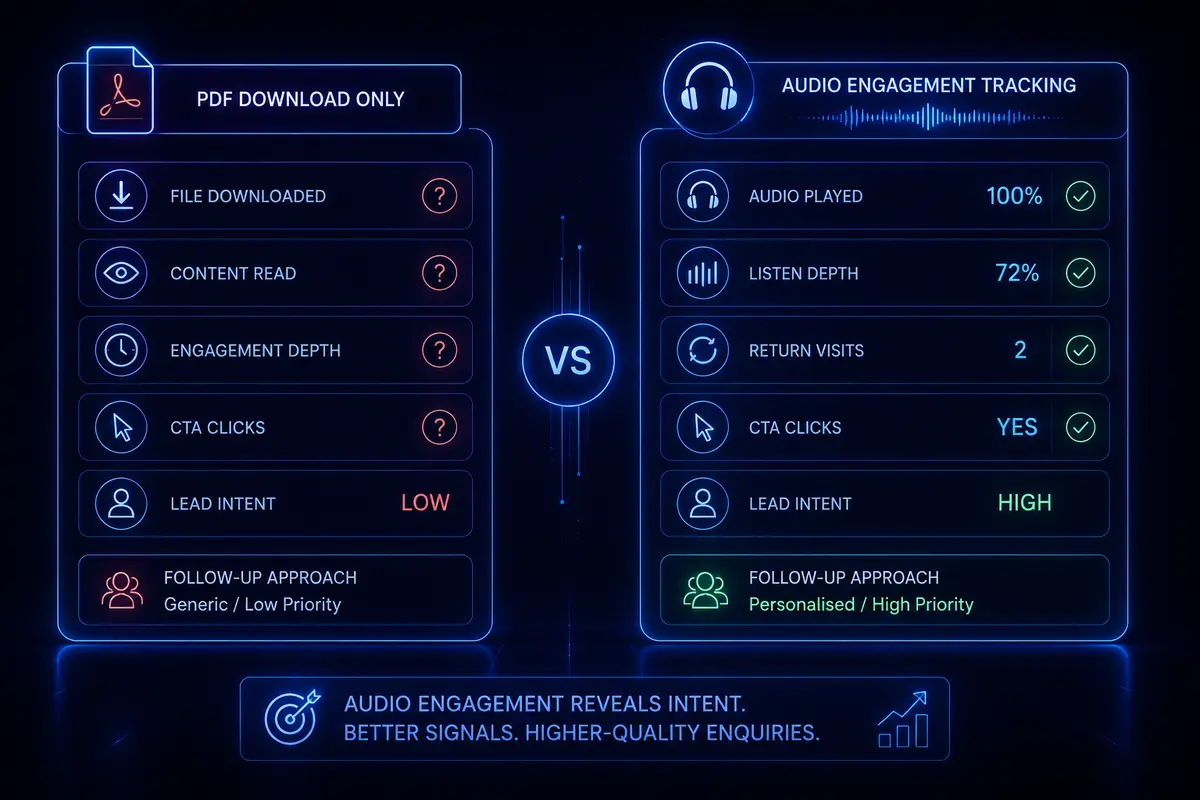
A download is a very weak engagement signal.
A prospect may download your guide and never read it. Another prospect may read half of it, send it to a spouse, return three days later, and then book a call.
If both people are treated the same in your CRM, your follow-up process is missing context.
This matters even more for inheritance tax content because the subject is sensitive. A prospect may not rush to book a call after one visit. They may need to come back, listen, share, compare, and think.
That is why relying only on “PDF downloaded” can be misleading.
It tells you someone wanted access.
It does not tell you whether they paid attention.
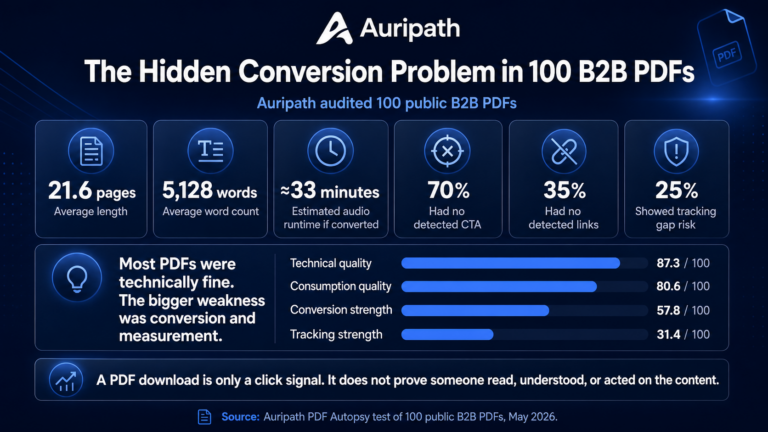
That is exactly the problem we explored in our PDF engagement benchmarks report, where we looked at how business PDFs often fail to convert attention into measurable action.
Better inheritance tax guide leads come from understanding attention, not just counting downloads.
Why audio works well for inheritance tax guides
Audio works because it lowers the effort required to engage with longer educational content.
A 20-page PDF may feel like homework.
A 10-minute audio guide feels easier to start.
That matters when the subject is complex, personal, or emotionally loaded.
People can listen while walking. They can listen in the car. They can listen with a partner. They can return later without having to find where they left off in a document.
Audio also fits modern content behavior. People are used to consuming useful information through podcasts, narrated articles, videos, and short audio explainers.
For wealth managers, the key point is simple:
If the guide is important enough to create, it is important enough to make easier to consume.
And audio does not need to change the message.
The safest version is usually to turn the existing adviser-approved guide into an audio version that follows the same structure, the same tone, and the same approved wording.
That keeps the campaign focused on format, distribution, and measurement, not on adding new financial commentary.
Turn the guide into a focused landing page, not just a file
The biggest mistake is treating the PDF as the whole campaign.
It is not.
The PDF may be the source material, but the landing page is where the visitor decides whether to engage, unlock the audio, download, inquire, or leave.
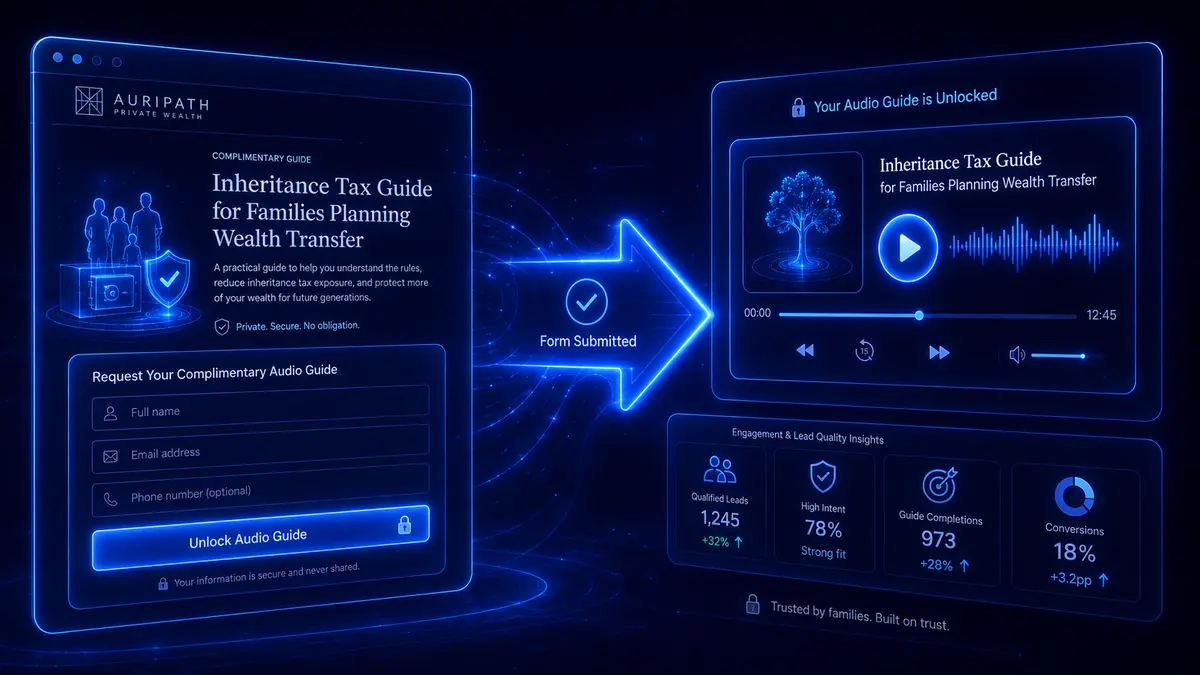
For the firm, the build sequence looks like this:
Approved guide → audio version → focused landing page → promotion → engagement tracking → lead capture → segmented follow-up.
For the prospect, the journey is different:
Visitor arrives → reviews the guide page → submits the form or downloads the PDF → listens to the audio guide → takes action → receives follow-up based on engagement.
That is why your landing page should not be a generic blog post with a PDF link at the bottom.
It should be a focused page built around one topic, one audience, and one next step.
Google’s own guidance on landing page experience says that relevance and usefulness matter. That is especially important if you are running search ads to the page.
A strong inheritance tax guide landing page should include:
- A clear headline that says who the guide is for.
- A short explanation of what the listener or reader will learn.
- A clear audio unlock section, not buried below several unrelated sections.
- A PDF option for people who still prefer to read.
- A short lead form that does not ask for too much too early.
- Trust signals, such as adviser credentials, firm information, privacy reassurance, or relevant accreditations.
- One clear CTA, such as requesting a private conversation or speaking to an adviser.
The audio unlock section should appear early because it gives the visitor a clear reason to engage.
If you hide the guide below a long introduction, you are making the prospect work too hard.
For this audience, the tone should feel calm, professional, and private. Avoid aggressive urgency. Avoid loud claims. Avoid anything that feels like a generic software landing page.
The page should feel like a trusted resource, not a sales trap.
Already have an inheritance tax guide?
Before creating another PDF, run your existing guide through PDF Autopsy to see where it may be losing attention, missing calls to action, or failing to create measurable engagement.
Use softer CTAs for a high-trust audience
Many wealth management pages use CTAs that are either too vague or too aggressive.
“Download now” can be too weak.
“Book a call today” can be too abrupt.
Inheritance tax content usually needs a more considered CTA because the subject is sensitive.
Better options include:
- Request a private conversation
- Speak to an adviser
- Request a guide follow-up
- Get the guide by email
- Unlock the audio guide
You can also use different CTAs at different points on the page.
Near the guide section, the CTA can be simple:
Unlock the audio guide.
After the listener has engaged with the content, the CTA can become more commercial:
Request a private conversation.
That sequence matters.
You are not forcing the visitor to make a decision before they trust you. You are giving them a useful way to engage first.
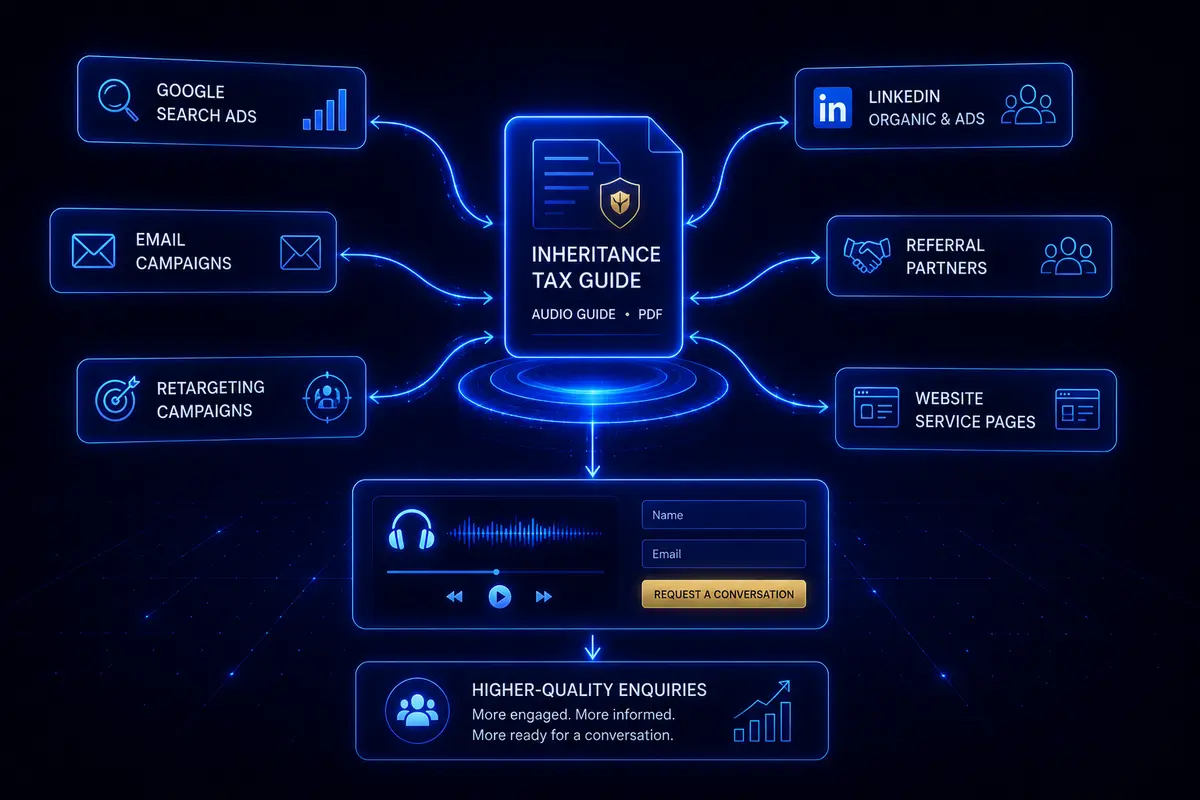
Promote the guide across more than one channel
Creating the audio guide is only step one.
The guide needs distribution.
The best promotion strategy depends on whether you are trying to capture existing demand, build trust with a defined audience, or re-engage people who already showed interest.
1. Google Search Ads
Google Search is usually a strong high-intent channel because it reaches people who are already searching for the topic.
For this type of campaign, you would usually want tightly grouped keywords around guide-based and adviser-seeking intent.
Examples include:
- inheritance tax guide
- inheritance planning guide
- estate planning guide
- family wealth planning
- next generation wealth guide
- inheritance tax guide leads
The key is to keep the ad and landing page aligned.
If the ad promises an inheritance tax guide, the page should immediately show the guide, explain who it is for, and offer the audio version.
Financial services advertising rules vary by country and platform, so firms should check local requirements before running campaigns.
2. LinkedIn
LinkedIn is useful when the target audience includes business owners, senior professionals, executives, partners, directors, or referral partners.
According to LinkedIn’s own ad targeting documentation, advertisers can target using professional attributes such as job title, seniority, function, company, skills, and experience.
For an inheritance tax guide, LinkedIn can work well for:
- Business owners
- Company directors
- Senior executives
- Accountants
- Solicitors
- Estate planners
- Private client professionals
- Referral partners
The message should not feel like a hard sell.
For example:
“A shareable audio guide for families reviewing long-term wealth planning conversations.”
That is calmer and more appropriate than shouting about savings or urgent action.
3. Meta and Facebook retargeting
Meta can be useful for education and retargeting, but it needs care.
Meta has a special ad category for financial products and services, which can restrict targeting options in some markets.
That means the strategy should not rely on overly narrow demographic targeting.
A better use case is retargeting people who have already visited the guide page, submitted the form, started listening, clicked a CTA, or downloaded the PDF, subject to consent and privacy requirements.
For example:
“Still reviewing the guide? You can return to the audio version when you are ready.”
This is not trying to create demand from scratch. It is bringing back people who already showed some interest.
4. Email campaigns
Email is one of the cheapest ways to distribute the guide if you already have permission to contact the audience.
You can send it to:
- Existing clients
- Past inquiries
- Newsletter subscribers
- Event attendees
- Referral partners
- Professional introducers
The email should be simple.
Do not overcomplicate it.
Something like this works:
“We have created an audio version of our inheritance tax guide for people who prefer to listen rather than read the full PDF.”
That frames the resource as useful, not pushy.
5. Referral partner distribution
This is one of the most underrated channels for wealth managers.
Accountants, attorneys, solicitors, will writers, estate planners, business advisers, and private client professionals are often close to the conversations where inheritance and estate planning questions come up.
A well-packaged guide gives them something useful to share.
But it needs to feel partner-safe.
That means:
- Professional tone
- No exaggerated claims
- Clear authorship
- Easy sharing link
- Optional PDF version
- Audio version for easier consumption
You can even create a partner version of the landing page with softer language and a CTA such as:
“Share this guide with a client or family member.”
Track attention, not just downloads
This is where audio becomes especially useful.
A normal PDF funnel often looks like this:
Visit → form fill → PDF download → follow-up.
That is basic.
An audio guide funnel can give you richer signals:
Visit → form fill → audio unlocked → play → listen depth → return visit → CTA click → booked conversation.
That is much more useful.
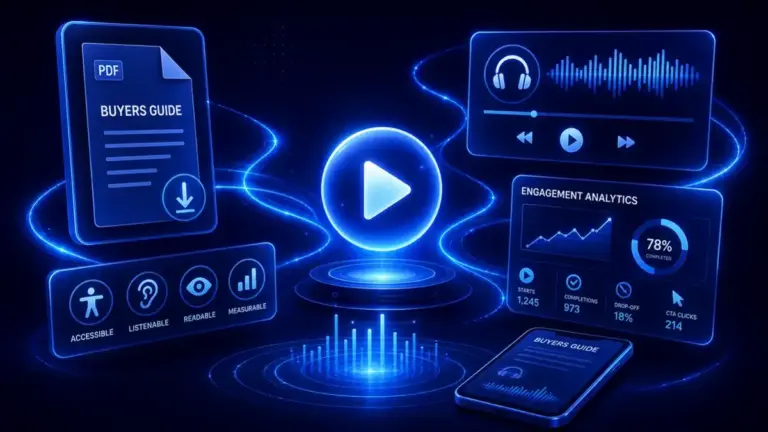
With audio, you can measure whether someone started listening, how far they got, whether they returned, and whether they clicked the next step after consuming the content.
Useful engagement signals include:
- Audio play starts
- 25%, 50%, 75%, and 100% listen depth
- Repeat visits
- PDF downloads
- CTA clicks
- Form starts
- Form submissions
- Booked calls
Google Analytics 4 is built around event tracking, and Google’s own documentation explains how events work in GA4.
You do not need to treat every event as a conversion.
But you should use these events to understand lead quality.
For example:
- A visitor who bounces after 10 seconds is cold.
- A visitor who downloads the PDF but never returns is mildly interesting.
- A visitor who listens to 75% of the guide and clicks “Request a private conversation” is much more interesting.
That is the core value.
Audio turns passive content into measurable attention.
That is also how firms can improve the quality of their inheritance tax guide leads without creating an entirely new campaign from scratch.
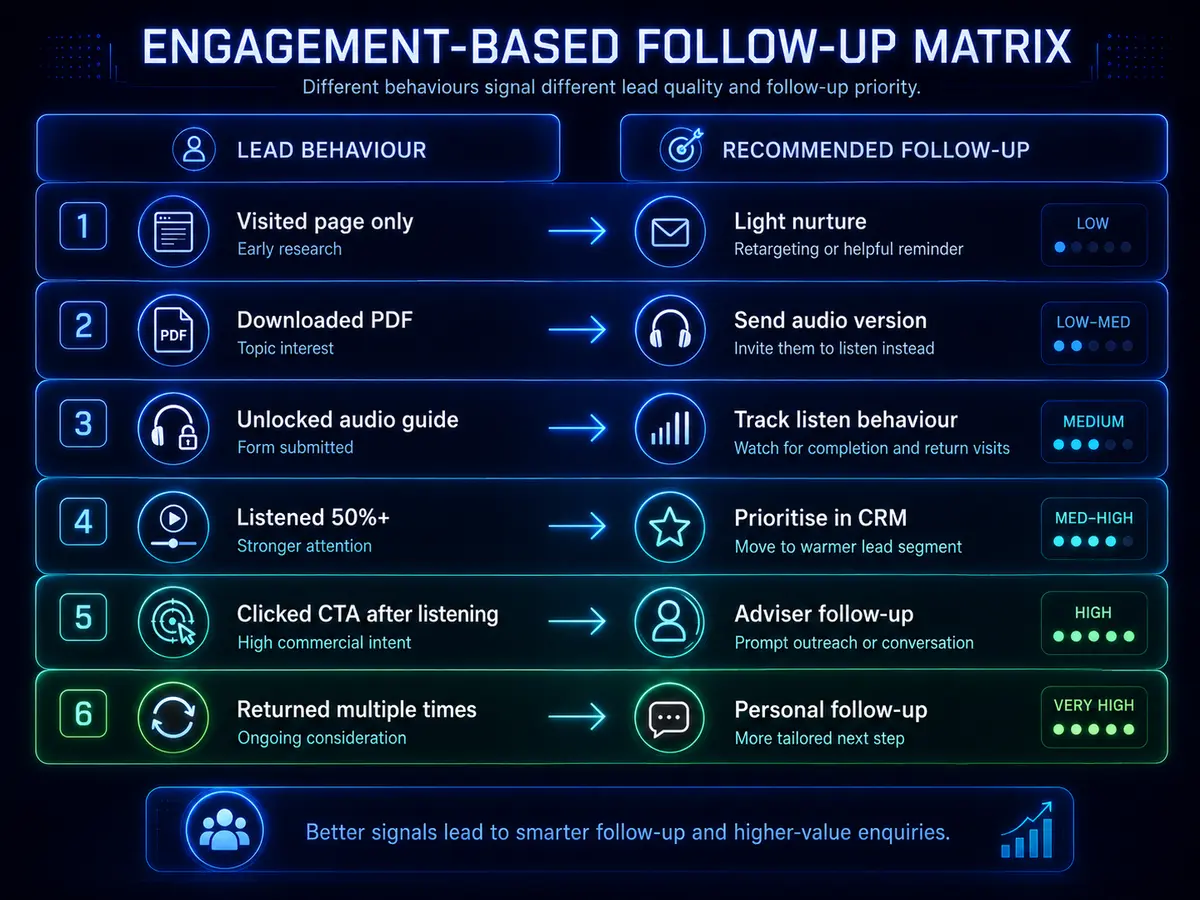
Use listen behavior to prioritize follow-up
Not every lead should be treated the same.
A person who fills out a form and listens to most of the guide is different from someone who fills out a form and never returns.
You can use engagement data to prioritize follow-up.
| Lead behavior | What it suggests | Follow-up approach |
|---|---|---|
| Visited page only | Low intent or early research | Retargeting or light nurture |
| Downloaded PDF | Topic interest | Email the audio version |
| Unlocked audio guide | Form submitted | Track listen behavior |
| Listened to 50% or more | Stronger attention | Prioritize in CRM |
| Listened and clicked CTA | Stronger inquiry intent | Prompt adviser follow-up |
| Returned multiple times | Ongoing consideration | Send a more personal next step |
This makes follow-up feel more intelligent.
Instead of saying, “You downloaded our guide,” your internal team can see that someone actually engaged with the resource.
That is a much stronger signal.
Use one approved guide across multiple campaign assets
You do not need to create a huge content program from scratch.
Start with one strong guide.
Then repurpose it into multiple formats.
- Website landing page
- Audio guide
- PDF download
- Email campaign
- LinkedIn post
- Google Search ad landing page
- Referral partner resource
- Retargeting campaign
- Short summary for follow-up emails
This keeps the campaign efficient.
It also helps keep the message consistent because everything comes from the same approved source.
That is important in financial services.
Your goal is not to create lots of disconnected marketing content.
Your goal is to make one trusted resource work harder.
That is the difference between collecting inheritance tax guide leads and building a proper lead-generation system around the guide.
Common mistakes to avoid
Here are the mistakes that weaken this kind of campaign.
1. Hiding the guide too far down the page
If the guide is the main asset, show it early.
Do not bury it after a long introduction, a generic banner, and three paragraphs about your firm.
2. Gating everything before the visitor understands the value
Gating can work, but the visitor needs to understand what they are getting.
For high-value audiences, it is often better to keep the form short and make the value of the audio guide clear before asking for details.
3. Using generic CTAs
“Submit” is weak.
“Download now” is basic.
Use language that fits the decision context, such as “Request a private conversation” or “Unlock the audio guide.”
4. Treating every download as equal
A download is useful, but it is not the same as attention.
Track what happens after the download.
5. Making the page too busy
Do not add every service, every testimonial, every team member, and every brochure to the same page.
Keep the page focused on the guide and the next step.
6. Changing the substance of the approved guide
If the guide has already been reviewed, the audio version should stay close to it.
Do not turn it into a loose commentary piece with extra claims.
7. Ignoring compliance and privacy
Paid ads, retargeting, email nurture, tracking pixels, and financial services messaging all need proper review.
The exact requirements vary by location, regulator, platform, and firm type. Before running campaigns, firms should check the relevant advertising, privacy, and financial promotion rules in their own market.
How Auripath helps
Auripath helps wealth management and advisory teams turn existing PDF guides into branded audio resources with lead capture and engagement tracking.
For an inheritance tax guide, the value is not just having an audio version. The value is seeing what happens after someone reaches the page: whether they unlock the guide, start listening, return later, click the CTA, or request a conversation.
That gives your team a clearer view of which inheritance tax guide leads are showing real attention, not just which names came through a form.
The fastest starting point is to audit the guide you already have. Run it through PDF Autopsy to check how well it works as a content asset, including length, CTA visibility, link gaps, and conversion issues.
Then, if the guide is worth turning into a campaign, speak to Auripath about creating a branded audio version with a focused landing page, lead capture, and listener engagement data.
The simple framework
If your firm already has an inheritance tax guide, do not start by asking whether you need another PDF.
Start by asking whether the guide you already have is easy to consume, easy to share, and easy to measure.
The framework is simple:
- Start with an approved guide.
- Turn it into an audio version.
- Build a focused landing page around it.
- Promote it through search, email, LinkedIn, referral partners, and retargeting.
- Track attention, not just downloads.
- Prioritize follow-up based on engagement.
That is how a static guide becomes a better lead-generation system.
Not by shouting louder.
Not by giving more away.
And not by treating every download as equal.
By helping the right prospects consume the content, trust the firm, and take the next step when they are ready.
That is how wealth managers can turn static PDFs into better inheritance tax guide leads.
Further reading
- Run a PDF Autopsy on your own guide
- PDF Engagement Benchmarks: What We Learned From Auditing 100 Public B2B PDFs
- Capgemini: Wealth advising trends
- Google Ads landing page experience guidance
- Meta financial products and services special ad category
- LinkedIn Ads targeting options

Get the free audio ebook for better B2B follow-up.
Learn how to turn PDF downloads, listening behavior, and CTA clicks into stronger sales conversations.