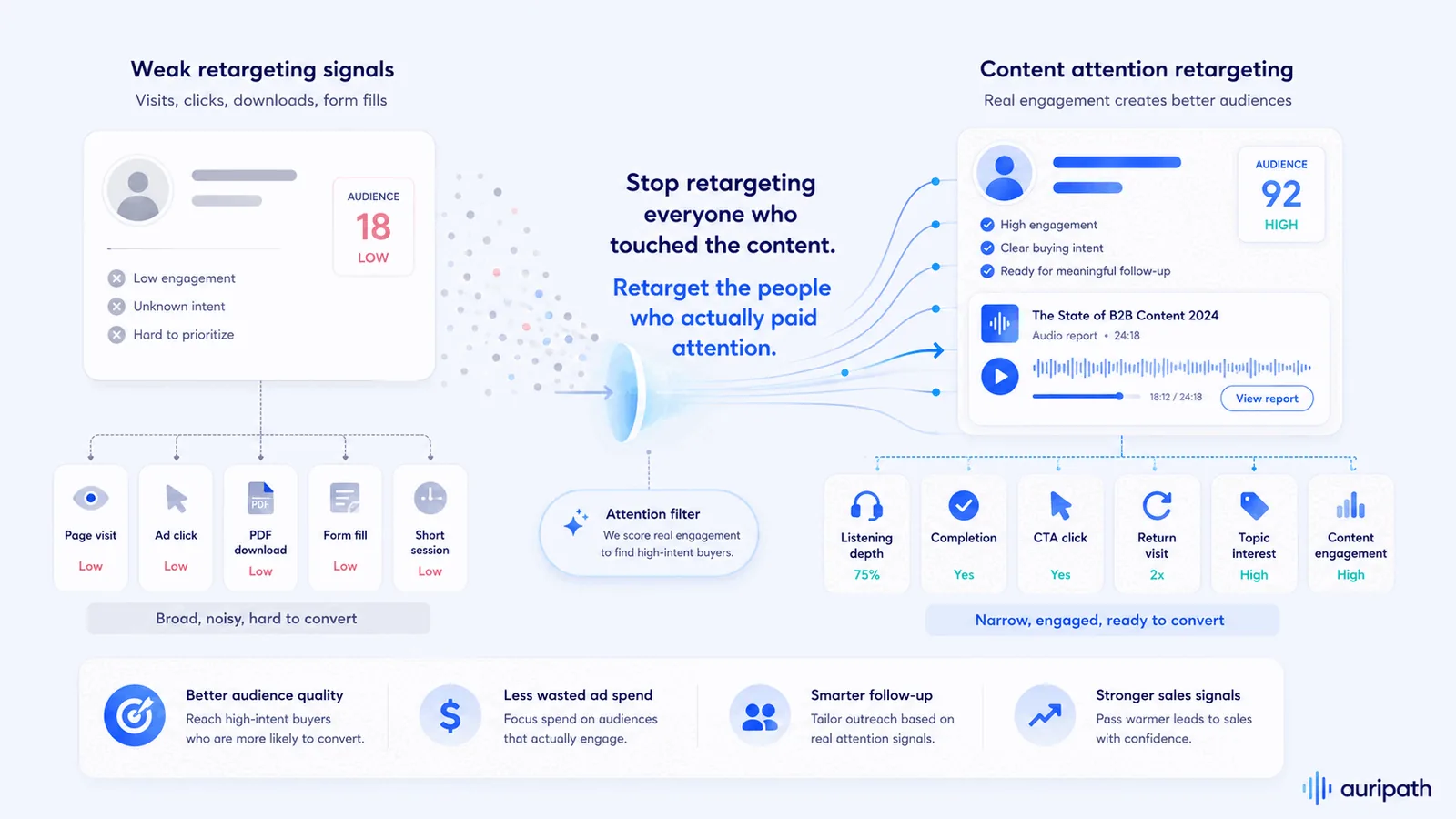
Most B2B retargeting audiences are built on weak signals.
A page visit. An ad click. A form fill. A PDF download.
These actions matter — but they rarely prove real interest. Someone can land on a page for six seconds, click an ad by mistake, or download a guide they never open. Traditional retargeting treats all of these people the same.
Content attention retargeting fixes this. It builds audiences based on how deeply someone actually engaged with your content, not just whether they touched it once.
Stop retargeting everyone who touched the content.
Retarget the people who actually cared.
What Is Content Attention Retargeting?
Content attention retargeting uses real engagement signals from your content assets to decide who should be retargeted, suppressed, scored higher, or moved into sales follow-up.
Instead of asking “Who visited or downloaded?”, it asks:
“Who actually paid attention?”
This matters in B2B because buying decisions are rarely instant. Prospects research, compare options, read deeply, share internally, and return later. A simple download or page view doesn’t tell you who is genuinely interested.
Why Traditional Retargeting Audiences Are Too Noisy
Traditional retargeting puts very different people into the same audience:
- Someone who bounced after five seconds
- Someone who clicked an ad by mistake
- Someone who downloaded a guide but never opened it
- Someone who spent 12 minutes with your buyer guide and clicked the demo CTA
When these people receive the same ads, you waste budget on low-intent users while under-serving high-intent prospects.
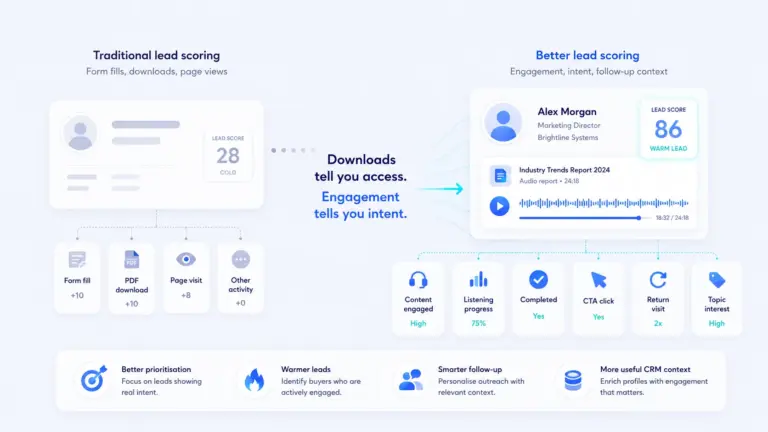
Content Attention Retargeting vs Traditional Retargeting
|
Traditional Retargeting Surface-level actions
“This person was here.” |
Content Attention Retargeting Depth of engagement
“This person paid attention.” |
8 Ways to Use Content Attention Retargeting
1. Audio Attention Retargeting
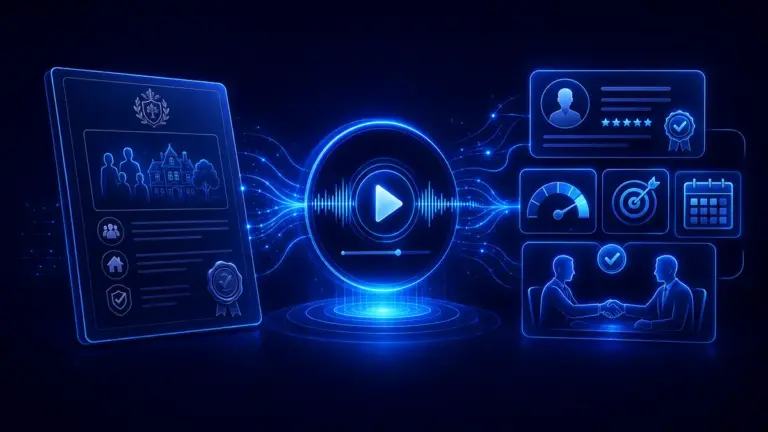
Turn PDFs, reports, and guides into embedded audio experiences. Track plays, listening depth (25%, 50%, 75%, completion), and CTA clicks. Deep listeners are far more valuable than simple downloaders.
2. PDF & Report Engagement Tracking
Move beyond “Did they download?” to “Did they actually engage?” Track time spent, pages viewed, and whether they returned to the asset.
3. Video Watch-Depth Retargeting
Apply the same logic you already use for video (25%, 50%, 75%, 100% watched) to written and audio content.
4. CTA-Based Retargeting
Someone who consumes content and clicks a pricing, demo, or comparison CTA is showing clear intent. Use these clicks to trigger more relevant follow-up ads.
5. Topic-Based Retargeting
Different topics should trigger different messages:
- Pricing content → ROI and proof messaging
- Implementation content → Onboarding and time-to-value messaging
- Compliance content → Security and risk messaging
6. Sequential Retargeting
Change the next ad based on engagement level:
- Low engagement → Educational explainer
- Medium engagement → Related case study or guide
- High engagement → Demo or pricing offer
- Clicked CTA but didn’t convert → Objection-handling content
7. Suppression Audiences
Use attention data to stop showing ads to the wrong people:
- People who downloaded but never engaged
- Existing customers
- People who already booked a meeting
- Low-fit or low-attention leads
8. High-Attention Lookalike Audiences
Build lookalike audiences from people who showed strong engagement (deep consumption + CTA clicks) instead of every form fill. Cleaner seed audiences produce better results.
Why Content Attention Beats Simple Downloads
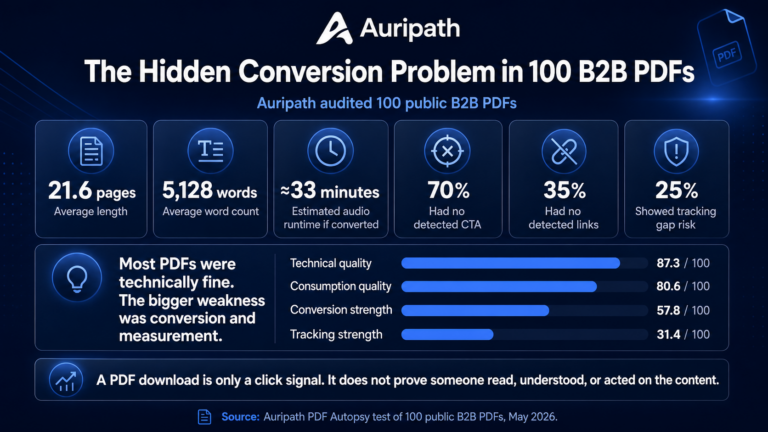
A download is a weak signal. Someone can download your guide and never open it.
Content attention reveals what actually happened next:
- Did they consume most of the asset?
- Did they return later?
- Did they click a meaningful CTA?
- Did multiple people from the same company engage?
These are much stronger indicators of real buying interest.
Practical Examples
Example 1: High-Attention Guide Listeners
A prospect listens to 80% of your buyer guide but doesn’t book a demo. Add them to a warmer audience showing case studies, pricing, or a direct demo CTA.
Example 2: Suppress Weak Downloaders
Someone downloads a PDF, never opens it, clicks no CTAs, and never returns. Suppress them from expensive retargeting campaigns and move them to lighter awareness sequences instead.
Example 3: Topic-Driven Follow-Up
A prospect engages heavily with implementation content. Show them ads focused on onboarding, integrations, and time to value — not generic brand messaging.
Example 4: Account-Level Interest
Three people from the same target account engage with your sales guide and one clicks a comparison CTA. This account now deserves stronger sales and marketing focus.
How to Turn Content Attention Into Usable Data
Tools like Auripath help B2B teams convert existing PDFs, guides, reports, and brochures into embedded audio experiences that capture listening depth, CTA clicks, and engagement signals.
These signals can then feed directly into your retargeting platforms, CRM, and sales workflows through integrations with HubSpot, Zapier, and n8n.
Final Thought
Most B2B retargeting is still built on shallow signals. Content attention retargeting gives you a clearer view of who actually cares.
When you know who paid attention, you can:
- Retarget more effectively
- Suppress the wrong people
- Build better lookalikes
- Give sales higher-quality leads
- Reduce wasted ad spend
The question is no longer just “Who converted?”
It’s “Who paid attention before they converted?”
That second question leads to much better audiences and much less wasted budget.

Get the free audio ebook for better B2B follow-up.
Learn how to turn PDF downloads, listening behavior, and CTA clicks into stronger sales conversations.