Most B2B lead scoring models have the same problem.
They give too much credit to actions that are easy to complete.
Someone fills in a form. Someone downloads a guide. Someone visits a page. The contact record gets updated. The lead score goes up. Sales may even get notified.
But here is the uncomfortable truth.
A form fill does not mean the person is ready to buy.
A PDF download does not mean the person read it.
A page view does not mean they understood the offer, compared options, or reached a point where a sales conversation makes sense.
That is why so many B2B teams end up in the same argument.
Marketing says, “We generated leads.”
Sales says, “These leads are weak.”
The CRM shows activity, but not enough context to explain what the person actually cared about.
This is where traditional B2B lead scoring starts to break down.
Not because lead scoring is a bad idea.
Because many lead scoring models are built on weak signals.
What is B2B lead scoring?
B2B lead scoring is the process of ranking leads based on how closely they match your ideal customer profile and how strongly their behavior suggests interest. HubSpot frames lead scoring around fit, engagement, or both, which is a useful way to separate “is this the right kind of company?” from “is this person actually showing interest?” HubSpot’s lead scoring software page is a useful reference point for that distinction.
In plain English, it is supposed to help you answer one question:
Which leads are worth following up first?
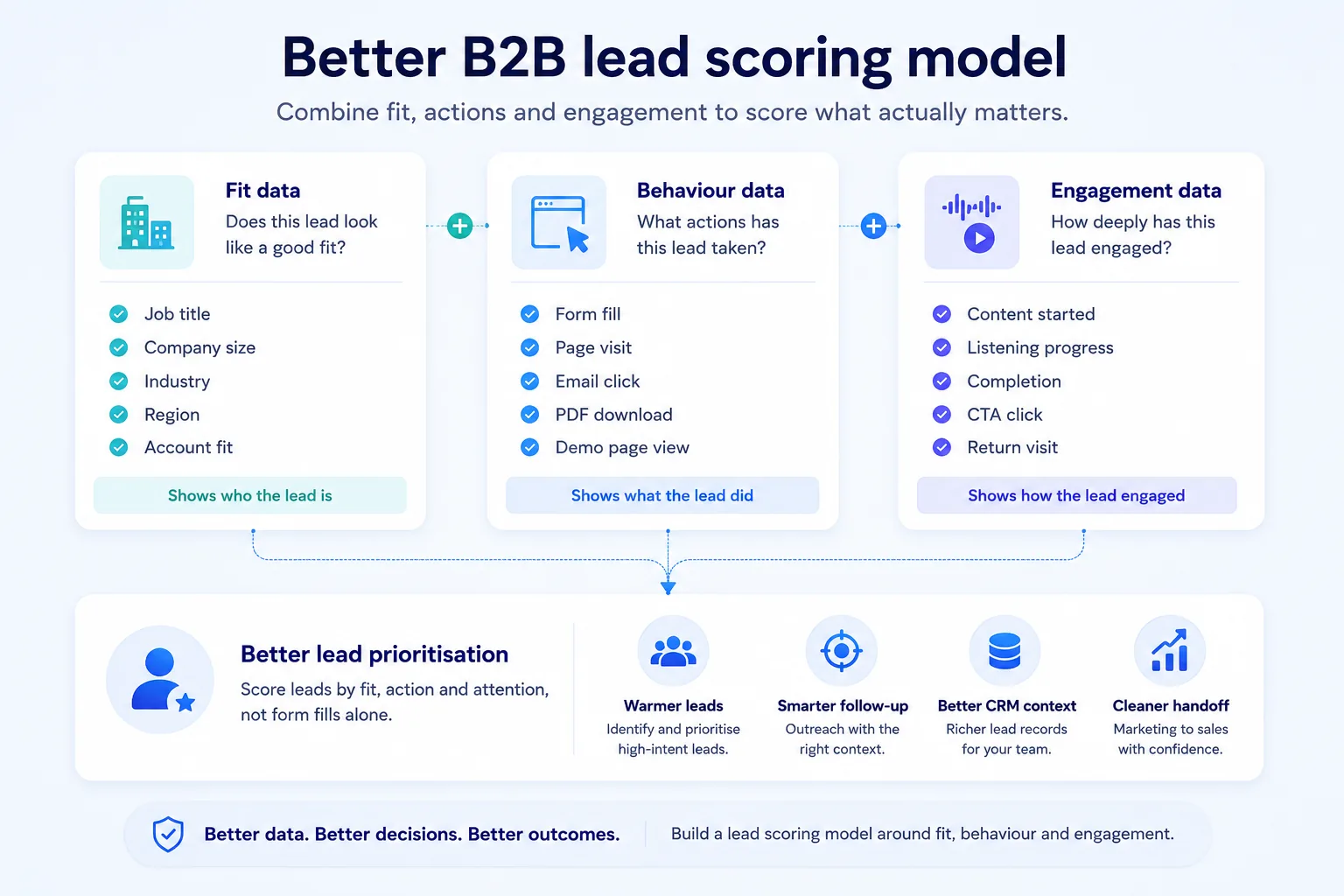
A good lead scoring model usually combines two types of data.
1. Fit data
Fit data tells you whether the lead looks like the kind of customer you want.
That might include:
- Job title
- Company size
- Industry
- Region
- Company type
- Technology used
- Budget or buying authority indicators
2. Behavior data
Behavior data tells you what the person has done.
That might include:
- Website visits
- Form submissions
- Email clicks
- Resource downloads
- Webinar registrations
- Pricing page visits
- Demo page visits
These inputs are useful.
But they are not enough.
The missing layer is content engagement analytics.
Not just what someone clicked.
What they actually spent time with.
The problem with traditional B2B lead scoring
Most traditional B2B lead scoring models are built around basic activity.
A person fills in a form, so they get points.
A person downloads a PDF, so they get points.
A person clicks an email, so they get points.
A person visits a page, so they get points.
This looks logical on the surface.
But it creates a serious problem.
It treats access as intent.
And access is not the same as intent.
A form fill is not a buying signal by itself
People fill in forms for many reasons.
They may be researching casually. They may be collecting resources. They may be comparing suppliers. They may be a student, vendor, competitor, or poor-fit contact. They may want the file but have no serious interest in speaking to sales.
That does not make the form fill worthless.
It just means the form fill should not carry too much weight on its own.
A form fill tells you someone raised their hand.
It does not tell you whether they kept paying attention.
A PDF download is not the same as content consumption
This matters because a lot of B2B content reporting stops at the download.
A visitor downloads a guide.
The campaign gets credit.
The contact goes into the CRM.
The lead score increases.
But what happened next?
Did they open it?
Did they read it?
Did they reach the section on implementation, pricing, compliance, ROI, or next steps?
Did they click a call to action?
Did they come back later?
In most systems, you do not really know.
Google Analytics can track useful events such as page views, outbound clicks, form submissions and file downloads, but a file download event still does not prove that the person consumed the document. Google’s enhanced measurement documentation is useful context here.
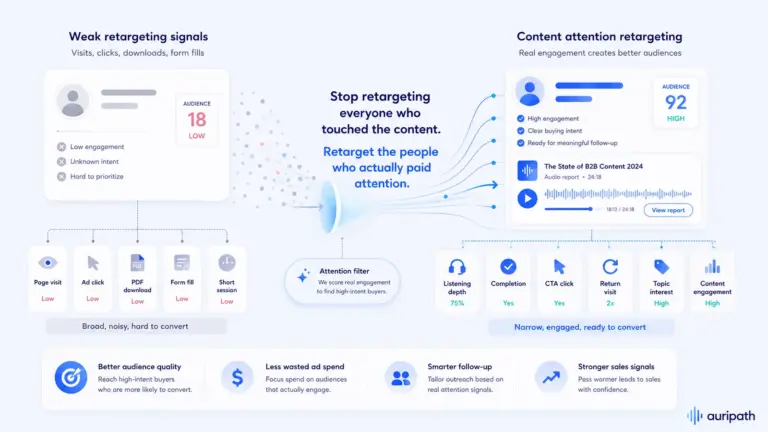
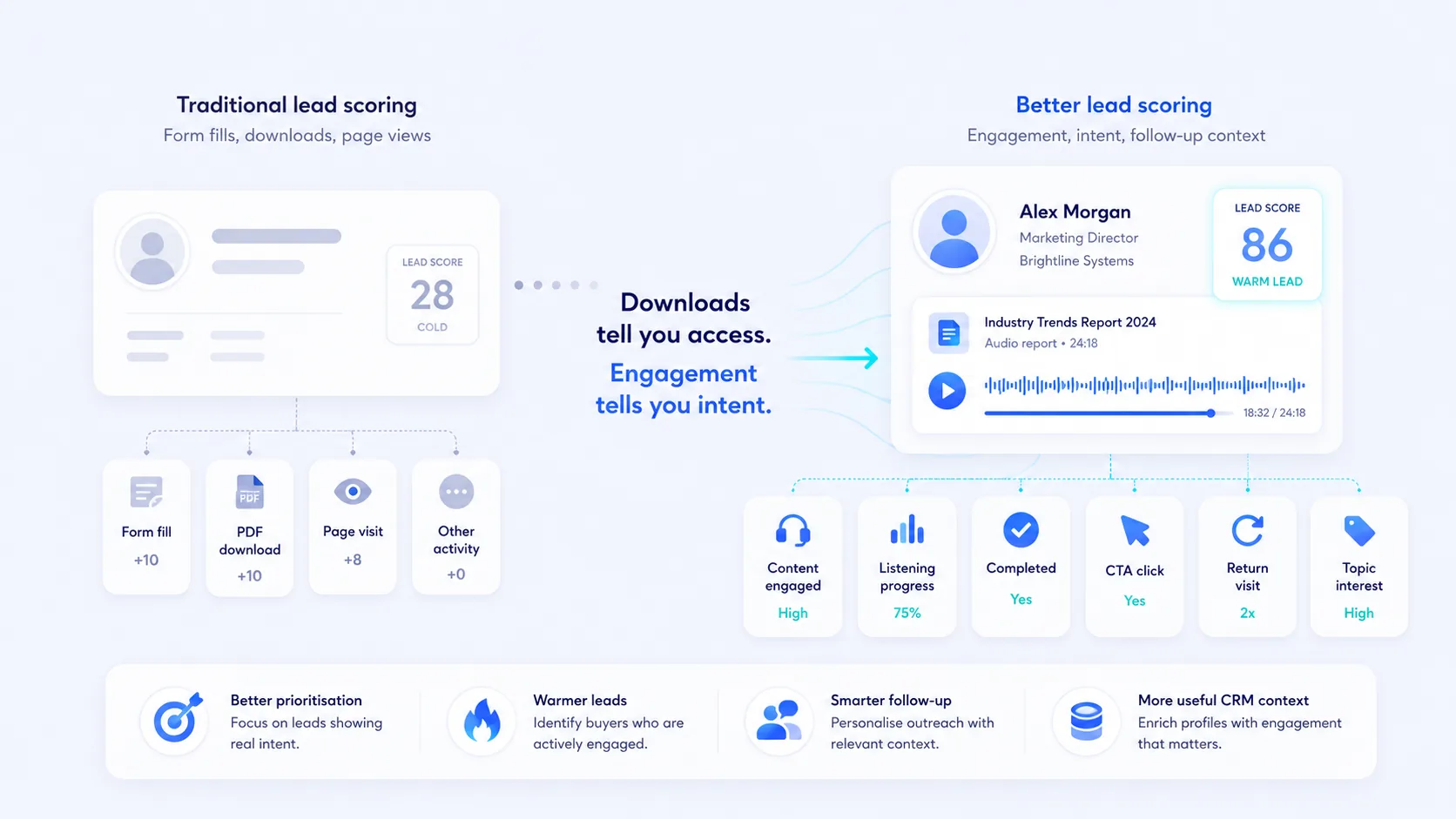
Downloads tell you access. Engagement tells you intent.
That is the gap.
Related reading: this is the same problem behind the content consumption gap and the B2B content follow-up gap.
Why downloads create weak lead scoring data
A download is a low-friction action.
It is easy to do.
That is why it is a weak signal when used alone.
Someone can download a report and never read it. Someone can save a guide for later and forget about it. Someone can click because the title looked useful, then disappear.
The download tells you the person wanted access.
It does not tell you what happened after access.
Here is a simple example.
Lead A
- Downloads your guide
- Opens it once
- Skims the first page
- Does not click anything
- Does not return
Lead B
- Starts the content experience
- Gets 75 percent of the way through
- Reaches the implementation section
- Clicks the call to action
- Returns the next day
In a basic CRM setup, both leads may look almost the same.
Both downloaded the guide.
But they are not the same.
Lead B has shown more attention, more interest, and more useful behavior for sales follow-up.
Your lead scoring model should know the difference.
Better B2B lead scoring needs content engagement data
Good B2B lead scoring should help sales and marketing answer practical questions.
- Which leads are worth following up first?
- Which contacts showed real attention?
- Which content assets created meaningful engagement?
- What topic does this person seem interested in?
- Which leads should enter a stronger nurture sequence?
- What should sales say when they follow up?
That is where content engagement data becomes useful.
Instead of only tracking that someone accessed a guide, report, brochure, white paper, or sales resource, you track what happened after that first interaction.
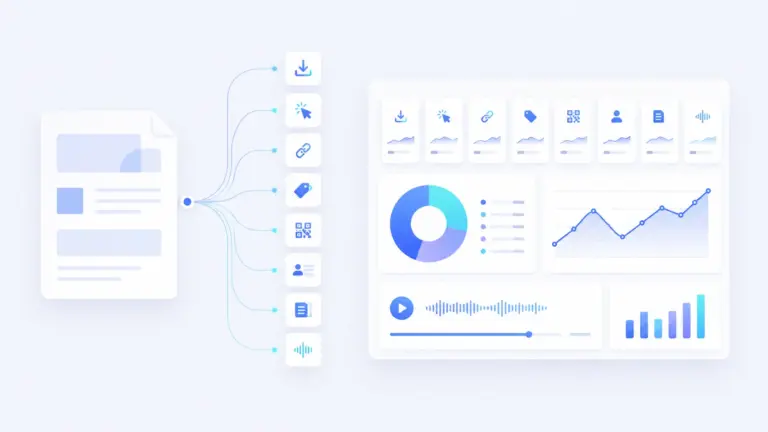
Useful content engagement signals can include:
- Player views
- Audio plays
- Listening time
- Listening progress
- Completion rate
- Drop-off points
- CTA clicks
- Return visits
- Asset-level performance
- Lead capture activity
- Per-lead engagement history
This gives your lead scoring model better inputs.
It moves the question from:
Did this person fill in a form?
To:
Did this person actually spend time with the content, and what did that behavior suggest?
Why engagement is a stronger signal than a download alone
Engagement is not perfect.
It does not magically prove that someone is ready to buy.
But it is stronger than a download alone because it shows attention.
If someone starts listening to a business guide, keeps listening, reaches a meaningful point, and clicks a call to action, that tells you more than the original download did.
It gives sales a better reason to follow up.
Compare these two follow-up messages.
Weak follow-up
Thanks for downloading our guide. Let me know if you have any questions.
Better follow-up
I saw you spent time with our implementation guide. Are you currently looking at how to improve content follow-up or lead scoring?
The second message is better because it is based on behavior.
It gives the salesperson a reason to start a relevant conversation.
That is what lead scoring should do.
It should not just create a number.
It should help people decide what to do next.
How content engagement improves lead prioritization
Lead scoring is only useful if it changes action.
If every form fill gets treated the same, your score is not helping much.
A better model separates shallow actions from stronger signals.
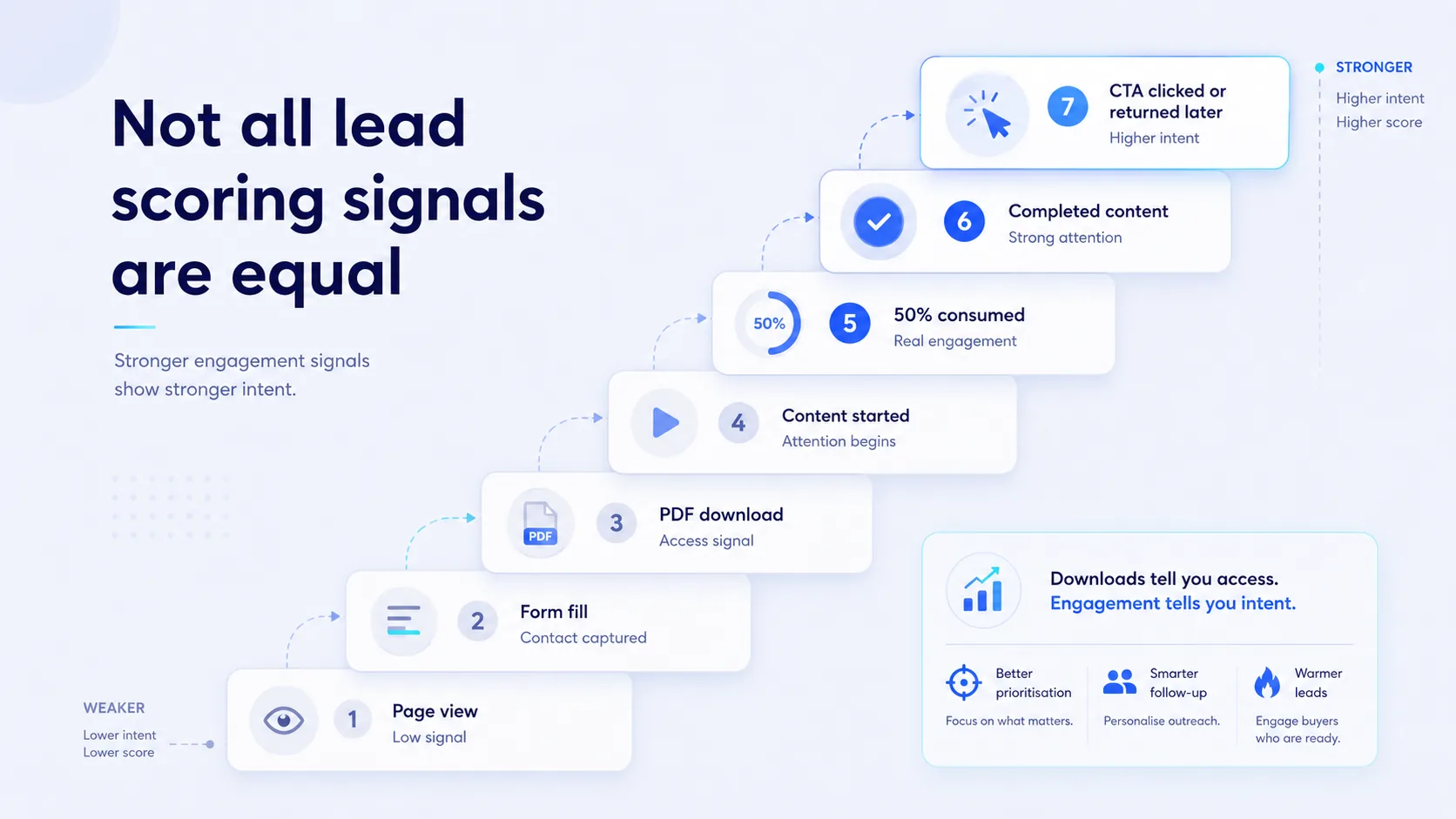
For example:
| Signal | Example score |
|---|---|
| Fits target industry | +10 |
| Target job role | +10 |
| Downloads guide | +5 |
| Starts audio experience | +10 |
| Reaches 50 percent | +10 |
| Completes asset | +20 |
| Clicks CTA | +20 |
| Returns within 7 days | +10 |
| Engages with high-intent asset | +15 |
| Uses personal email | -10 |
| No activity for 30 days | Score decay |
The exact numbers are not the point.
The principle is the point.
Do not score every action equally.
Give more weight to actions that show attention, intent, buying-stage relevance, or a clear next step.
Separate fit from engagement
One of the biggest mistakes in B2B lead scoring is mixing everything into one vague number.
A person can be a good-fit lead with low engagement.
Another person can be highly engaged but a poor fit.
Those are different situations.
A good-fit lead with no engagement may need nurture.
A poor-fit lead with high engagement may not be worth sales time.
The strongest leads usually combine:
- Good company fit
- Relevant role
- Recent activity
- Meaningful content engagement
- High-intent content topic
- Clear next-step behavior
That is a much better picture than “downloaded PDF”.
How audio analytics can improve B2B lead scoring
This is where audio becomes useful.
Not because every business document needs an audio version.
Not because audio is fashionable.
Because audio gives you measurable engagement behavior around content that would otherwise be hard to track.
A static PDF can sit behind a form with very little visibility.
An embedded audio experience can show what happened after someone arrived.
With audio analytics, you can see signals such as:
- Whether someone started listening
- How long they listened
- How far they got
- Whether they completed the resource
- Where they dropped off
- Whether they clicked a CTA
- Whether they became a captured lead
That gives you a clearer view of attention.
And attention is one of the missing inputs in many B2B lead scoring models.
You can learn more about this on the Auripath audio analytics page.
What different teams can do with better engagement data
Content engagement data is not just a marketing report.
It can help different teams make better decisions.
Sales
Sales can prioritize warmer leads, create better manual follow-up tasks, and see which asset, problem, topic, or CTA the prospect engaged with.
Marketing
Marketing can see which PDFs, guides, reports, brochures, white papers, and sales resources create real attention, not just clicks or downloads.
RevOps
RevOps can turn engagement events into cleaner CRM properties, lead score inputs, workflow triggers, lifecycle movement, and account-level signals.
Product and customer marketing
Product teams can spot directional signals around feature interest, objections, pricing-stage content, use cases, and which resources people return to.
Where Auripath fits
Auripath helps B2B teams turn static content assets into embedded, measurable audio experiences.
That means a guide, report, brochure, white paper, sales PDF, or educational resource can become something people engage with directly on your website.
With Auripath, you can add:
- Embedded audio experiences
- Lead capture
- Calls to action
- Playback analytics
- Completion signals
- Drop-off data
- CTA click tracking
- CRM-ready engagement signals
Instead of only knowing that someone accessed a content asset, you can see whether they actually engaged with it.
If the asset is long, the same logic applies to long PDF to audio: the point is not changing format for its own sake, but making useful content easier to consume and easier to measure.
That matters because your CRM can only work with the data you give it.
If the only signal is “downloaded PDF”, the follow-up will be thin.
If the signal is “listened to 75 percent of the implementation guide and clicked the CTA”, the follow-up gets sharper.
Auripath does not replace your CRM or marketing automation system.
It gives those systems better behavior data to work with.
You can connect engagement signals into tools and workflows through the Auripath integrations hub, including HubSpot, Zapier, n8n, Make, or your existing CRM process.
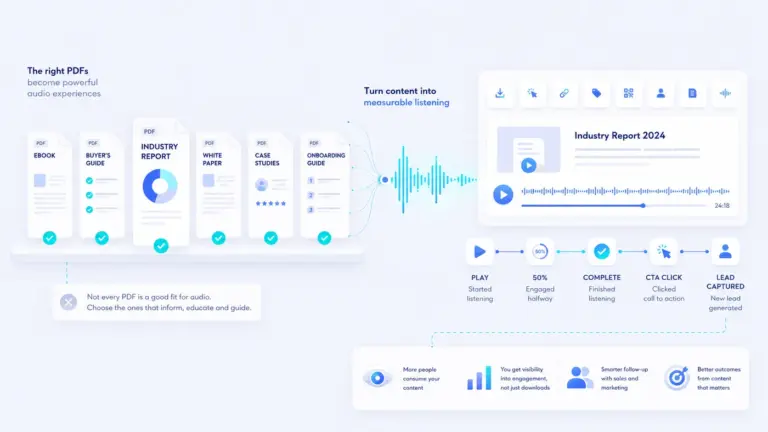
Example workflow: from content engagement to better follow-up
Here is a simple example of how this can work.
- A visitor lands on a guide page.
- They start the embedded audio experience.
- Auripath tracks listening progress.
- The visitor submits their details.
- They click a call to action.
- The engagement data is sent into your CRM or workflow tool.
- Sales follows up based on what the person actually engaged with.
This is not complicated.
But it is much more useful than treating every download the same.
The future of B2B lead scoring is attention-based
B2B teams do not need more empty lead records.
They need better signals.
They need to know which people are showing real interest, what they are interested in, and how to follow up without guessing.
Traditional lead scoring often starts with the form fill.
Better lead scoring looks at what happens after the form fill.
Did the person pay attention?
Did they engage with the content?
Did they reach a meaningful point?
Did they come back?
Did they click?
Did they show enough interest to justify a sales follow-up?
That is where content engagement data becomes valuable.
A form fill tells you who raised their hand.
Content engagement tells you whether they kept paying attention.
Frequently asked questions
What is B2B lead scoring?
B2B lead scoring is the process of ranking leads based on fit, behavior, engagement and likely sales readiness. It helps sales and marketing decide which leads should be prioritized first.
Why are form fills weak lead scoring signals?
A form fill shows that someone submitted their details. It does not prove they read the content, understood the offer, compared options or showed meaningful buying intent.
Is a PDF download a good lead scoring signal?
A PDF download can be useful, but it is incomplete. It shows that someone accessed the file. It does not show whether they opened it, consumed it, reached the important section or acted on it.
What is content engagement data?
Content engagement data shows what someone did after they accessed a resource. For an audio experience, this can include plays, listening time, completion, drop-off points, CTA clicks, return visits and lead capture activity.
How does content engagement improve B2B lead scoring?
It gives your lead scoring model stronger behavior signals. Instead of treating every download the same, you can give more weight to leads that actually engaged with the content, completed it, clicked a call to action or returned later.
How does this help sales follow-up?
Sales can follow up with better context. A lead record that says “listened to 75 percent of the implementation guide and clicked the CTA” is more useful than a record that only says “downloaded PDF”.
Does Auripath replace HubSpot or a CRM?
No. Auripath does not replace your CRM. It adds content-specific engagement data that can support CRM workflows, lead scoring, sales follow-up and marketing reporting.
What is the best first asset to track this way?
Start with a high-value guide, report, white paper, buyer’s guide or sales resource that already matters to your marketing or sales process. The best first asset is usually one where better engagement data would change follow-up decisions.

Get the free audio ebook for better B2B follow-up.
Learn how to turn PDF downloads, listening behavior, and CTA clicks into stronger sales conversations.